


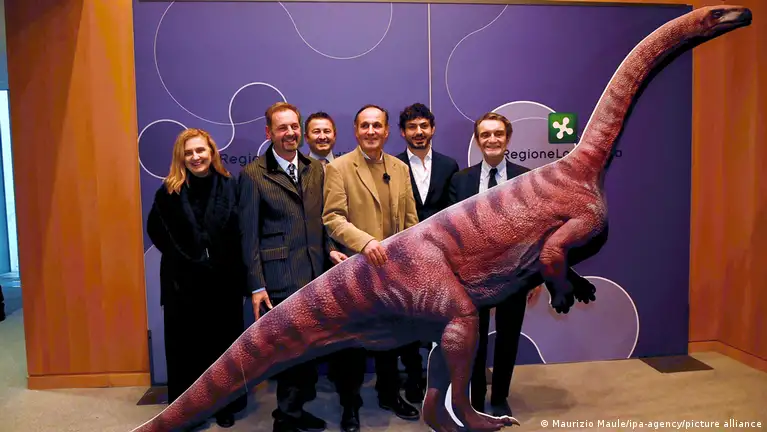
Italy Mass Dinosaur Footprint Discovery Near Olympics Venue Captivates Scientists
The Italy mass dinosaur footprint discovery near Olympics venue has captured global scientific attention after researchers uncovered an extraordinary concentration of prehistoric tracks close to a planned Olympic infrastructure site. According to Deutsche Welle (DW), the discovery includes hundreds of fossilised dinosaur footprints, offering rare insight into how these ancient creatures moved, interacted, and lived millions of years ago.
The find is being described as one of the most significant dinosaur track discoveries in Europe in recent decades. Its proximity to a modern Olympic venue has added an unexpected dimension, blending deep prehistory with contemporary development and raising important questions about conservation and heritage protection.
Where the Discovery Was Made
The footprints were found during geological and environmental surveys carried out ahead of construction work near a future Olympic venue in northern Italy. The region is already known for its complex geological layers, but the sheer number and clarity of the tracks surprised experts.
Key location highlights include:
-
The site lies close to infrastructure planned for upcoming Winter Olympic events
-
Footprints were preserved in sedimentary rock once part of a coastal or lagoon environment
-
The area is now under scientific and cultural protection review
Italy has a long history of palaeontological discoveries, but mass footprint sites of this scale remain rare, making this find especially valuable.
For background on Italy’s geological heritage, the Italian National Institute for Environmental Protection and Research provides extensive documentation:
https://www.isprambiente.gov.it/
What Makes This Discovery Unique
The Italy mass dinosaur footprint discovery near Olympics venue stands out due to several exceptional features that distinguish it from typical fossil finds.
Scientists highlighted the following characteristics:
-
Hundreds of footprints spread across a large rock surface
-
Multiple track sizes, suggesting different species or age groups
-
Clear walking patterns, indicating movement in groups rather than isolated animals
-
Excellent preservation, allowing researchers to analyse stride length and speed
Unlike skeletal fossils, footprints capture a moment in time, offering direct evidence of dinosaur behaviour rather than just anatomy.
What Scientists Have Learned So Far
Preliminary analysis suggests that the footprints date back roughly 70 to 80 million years, placing them in the Late Cretaceous period. Experts believe the tracks were left by herbivorous dinosaurs, possibly hadrosaurs or similar species known to move in herds.
Early findings indicate:
-
Dinosaurs likely moved together along a shoreline or shallow lagoon
-
The presence of smaller tracks suggests juveniles travelled with adults
-
The site may have been a migratory route or feeding ground
Such behavioural insights are rare and help scientists reconstruct ancient ecosystems with greater accuracy.
For an overview of how fossil footprints are studied, the Natural History Museum in London explains ichnology—the science of trace fossils—in detail:
https://www.nhm.ac.uk/discover/what-are-trace-fossils.html
The Olympic Connection and Conservation Concerns
The fact that the Italy mass dinosaur footprint discovery near Olympics venue was made during Olympic-related surveys has sparked debate about balancing development and preservation.
Authorities and scientists are now working together to:
-
Secure the site from damage during construction
-
Explore options to modify or reroute planned infrastructure
-
Assess whether the area could be opened for controlled public access
Italian cultural heritage laws provide strong protections for archaeological and palaeontological sites, and officials have indicated that safeguarding the footprints is a priority.
Italy’s Ministry of Culture oversees such protections and outlines heritage conservation frameworks here:
https://cultura.gov.it/
Why Dinosaur Footprints Matter More Than Bones
While dinosaur skeletons often attract public fascination, footprint sites like this one can be even more valuable scientifically.
Footprints help researchers understand:
-
Social behaviour, such as herd movement
-
Locomotion, including walking speed and posture
-
Environmental conditions, inferred from sediment and track depth
-
Interactions between species, when multiple track types are found together
The Italy mass dinosaur footprint discovery near Olympics venue provides a rare snapshot of daily dinosaur life, something bones alone cannot reveal.
Broader Significance for European Palaeontology
Europe has fewer large dinosaur track sites compared to regions like North America or China, making this Italian discovery particularly important.
Experts say it could:
-
Rewrite assumptions about dinosaur distribution in southern Europe
-
Encourage renewed exploration of similar geological formations
-
Strengthen Italy’s role in international palaeontological research
Institutions across Europe are already expressing interest in collaborating on further studies of the site.
For comparative context on major dinosaur track discoveries worldwide, the Smithsonian National Museum of Natural History provides an accessible overview:
https://naturalhistory.si.edu/education/teaching-resources/paleontology
Public Interest and Educational Potential
The discovery has sparked excitement beyond academic circles. Local communities, educators, and tourism planners see potential for:
-
Educational programmes focused on prehistory and earth science
-
Carefully managed geotourism initiatives
-
Increased awareness of Italy’s deep natural history
However, scientists caution that any public access must be strictly controlled to prevent erosion or vandalism of the delicate fossil surfaces.
What Happens Next
In the coming months, researchers will continue detailed mapping and 3D scanning of the footprints. These digital records will allow global collaboration without disturbing the physical site.
Next steps include:
-
Detailed species identification
-
Environmental reconstruction of the ancient landscape
-
Long-term preservation planning
The Italy mass dinosaur footprint discovery near Olympics venue is expected to remain under close study for years, potentially yielding new insights with each phase of research.
Conclusion
The Italy mass dinosaur footprint discovery near Olympics venue is a remarkable intersection of ancient history and modern development. Unearthed during preparations for a global sporting event, the site reminds us that beneath today’s cities and infrastructure lie stories stretching back tens of millions of years.
As Italy works to balance Olympic ambitions with scientific and cultural responsibility, this extraordinary find stands as a powerful example of why careful exploration and preservation matter—not just for researchers, but for humanity’s shared understanding of life on Earth.