


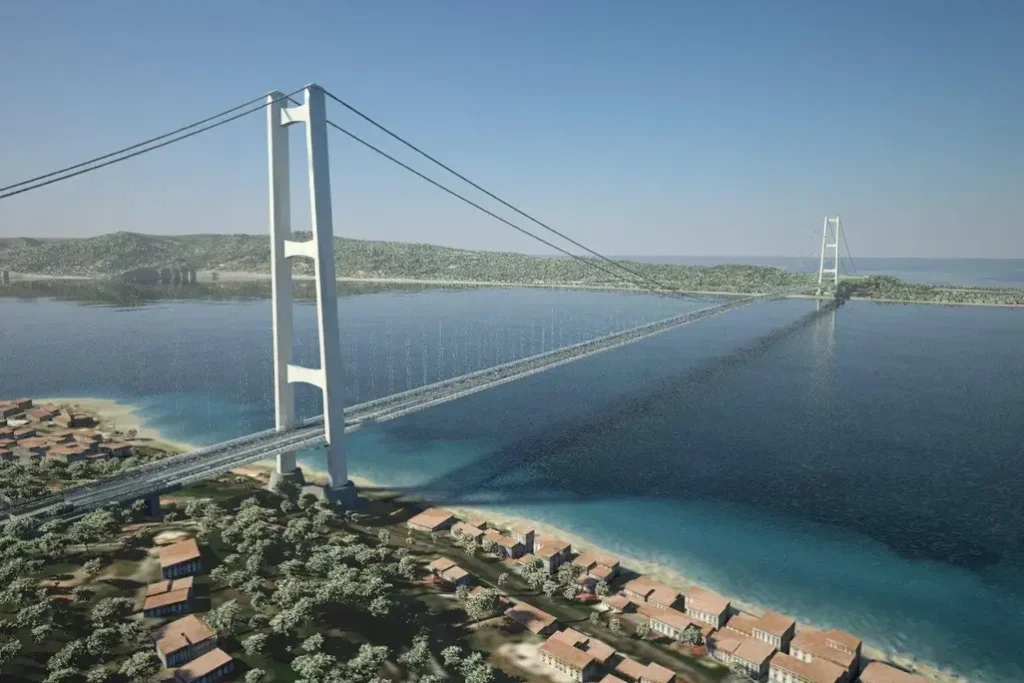
Italy Plans World’s Longest Suspension Bridge to Transform Southern Connectivity
Italy’s government has unveiled an ambitious infrastructure project as Italy plans world’s longest suspension bridge over the Strait of Messina, connecting the island of Sicily to the Calabria region on the Italian mainland. Covered by Deutsche Welle (DW), the proposal has reignited debate over large-scale public works, economic development, environmental impact, and engineering feasibility.
The project, long discussed and debated in Italian political and engineering circles, aims to enhance mobility, stimulate economic growth, and symbolise a leap forward in modern infrastructure. Its potential to become the world’s longest suspension bridge places it among the most daring engineering endeavours of the 21st century.
Why Italy Plans World’s Longest Suspension Bridge
The concept of bridging Sicily and mainland Italy is not new. For decades, planners have considered constructing a fixed link to eliminate reliance on ferries and improve year-round transport. Proponents argue that such a bridge would:
-
Reduce travel time between Sicily and the mainland, fostering economic integration
-
Boost tourism by improving accessibility
-
Create jobs during construction and in ongoing operations
-
Strengthen national infrastructure and resilience
Italy’s renewed push to ensure that Italy plans world’s longest suspension bridge reflects broader strategic goals of regional cohesion and competitiveness.
For background on the geography and historical context of the Messina Strait, the Encyclopaedia Britannica offers an overview:
https://www.britannica.com/place/Strait-of-Messina
Design and Engineering Ambitions
Details emerging about the bridge design hint at a structure that would surpass existing records for main span length. If completed as envisioned, the bridge could exceed 3,000 metres in span, outclassing today’s longest suspension bridges such as the Akashi Kaikyō Bridge in Japan.
Key design elements under discussion include:
-
Record-breaking main span: Pushing the limits of suspension bridge engineering
-
High structural clearance: To allow maritime traffic through the busy strait
-
Multimodal transportation: Dedicated lanes for vehicles, rail, and potentially future technologies
-
Innovative materials: Use of high-strength steel and earthquake-resilient design principles
Engineering specialists have noted that the strait’s complex geological conditions and seismic activity pose significant challenges. For insight into how large bridges accommodate seismic risk, the U.S. Federal Highway Administration provides technical guidance:
https://www.fhwa.dot.gov
Economic and Strategic Implications
The scale of the Italy plans world’s longest suspension bridge project extends far beyond engineering spectacle. Economists and policy analysts highlight potential transformative effects on regional development:
Economic Integration
By linking Sicily more directly with mainland Italy, the bridge could:
-
Encourage business investment in southern regions
-
Enhance supply chain efficiency by reducing reliance on ferry schedules
-
Improve labour mobility and cross-regional economic cooperation
Tourism and Cultural Exchange
Improved access could increase tourism flows into Sicily’s historic cities, coastal towns and cultural heritage sites. Better infrastructure often correlates with higher regional visitor numbers, expanding economic opportunities for local hospitality sectors.
Strategic National Connectivity
The bridge signifies a broader national commitment to investing in infrastructure that promotes cohesion between Italy’s diverse regions, potentially reducing longstanding economic disparities.
For broader context on how infrastructure impacts economic growth, the World Bank’s infrastructure overview offers useful analysis:
https://www.worldbank.org/en/topic/infrastructure
Environmental and Social Considerations
Despite enthusiasm from supporters, the plan has also drawn environmental and civil society scrutiny. Critics of the Italy plans world’s longest suspension bridge project emphasise potential risks:
-
Environmental disruption: Construction activities could affect marine ecosystems and coastal environments
-
Heritage preservation: Sicily and southern Italy host numerous protected cultural landscapes
-
Community impact: Local populations express concerns about displacement, noise, and changes to traditional ways of life
Environmental impact assessments will be critical to evaluating long-term consequences and ensuring sustainable development principles are upheld.
For perspectives on environmental assessments in major infrastructure projects, the European Environment Agency offers guidelines:
https://www.eea.europa.eu
Political and Public Response
The idea of the bridge has seen fluctuating levels of political support over time. At various points, Italian governments have advanced, shelved and revived the proposal depending on economic conditions, public sentiment, and competing priorities. The current administration’s announcement that Italy plans world’s longest suspension bridge underscores a commitment to advancing significant public works.
Political discourse around the bridge spans:
-
National pride in achieving engineering milestones
-
Debates over public investment priorities, especially in light of competing needs in healthcare, housing, and climate adaptation
-
Regional advocacy, particularly among Sicilian and southern Italian leaders seeking greater connectivity
Polling indicates a mix of optimism and scepticism among the Italian public, with perspectives shaped by economic expectations and concerns about cost and feasibility.
For context on Italian infrastructure planning processes, Italy’s Ministry of Infrastructure and Transport offers official policy information:
https://www.mit.gov.it
Comparisons With Global Suspension Bridges
If completed according to current proposals, the bridge would surpass existing suspension bridges in scale and ambition. Notable comparisons include:
-
Akashi Kaikyō Bridge (Japan): Currently the longest suspension bridge, with a central span of 1,991 metres
-
Xihoumen Bridge (China): Known for advanced engineering in marine conditions
-
Great Belt Bridge (Denmark): Blends long spans with integrated multimodal transport
These global precedents provide valuable reference points for designers and planners as they refine the Italian project.
For more on the world’s longest bridges and their engineering achievements, the List of longest suspension bridges page offers detailed comparative information:
https://en.wikipedia.org/wiki/List_of_longest_suspension_bridges
Next Steps and Timeframes
While the vision for the Italy plans world’s longest suspension bridge project has taken shape, significant steps remain before construction can begin:
-
Completion of comprehensive feasibility studies
-
Environmental impact evaluations and mitigation planning
-
Securing funding and public-private partnerships
-
Contracting and tendering with leading engineering firms
Government officials have indicated optimism about advancing the project, but timelines for actual construction remain tentative. As with other megaprojects, careful planning, public consultation, and technical assessment will be crucial.
Conclusion
The announcement that Italy plans world’s longest suspension bridge across the Strait of Messina represents a bold vision that blends ambition, engineering prowess and strategic development. It acknowledges infrastructure’s role in shaping economic opportunity and regional cohesion while highlighting the complex balance between innovation and sustainability.
As planning progresses, the project is likely to draw continued national and international attention, offering insights into how modern societies can leverage infrastructure to connect people, markets, and cultures.